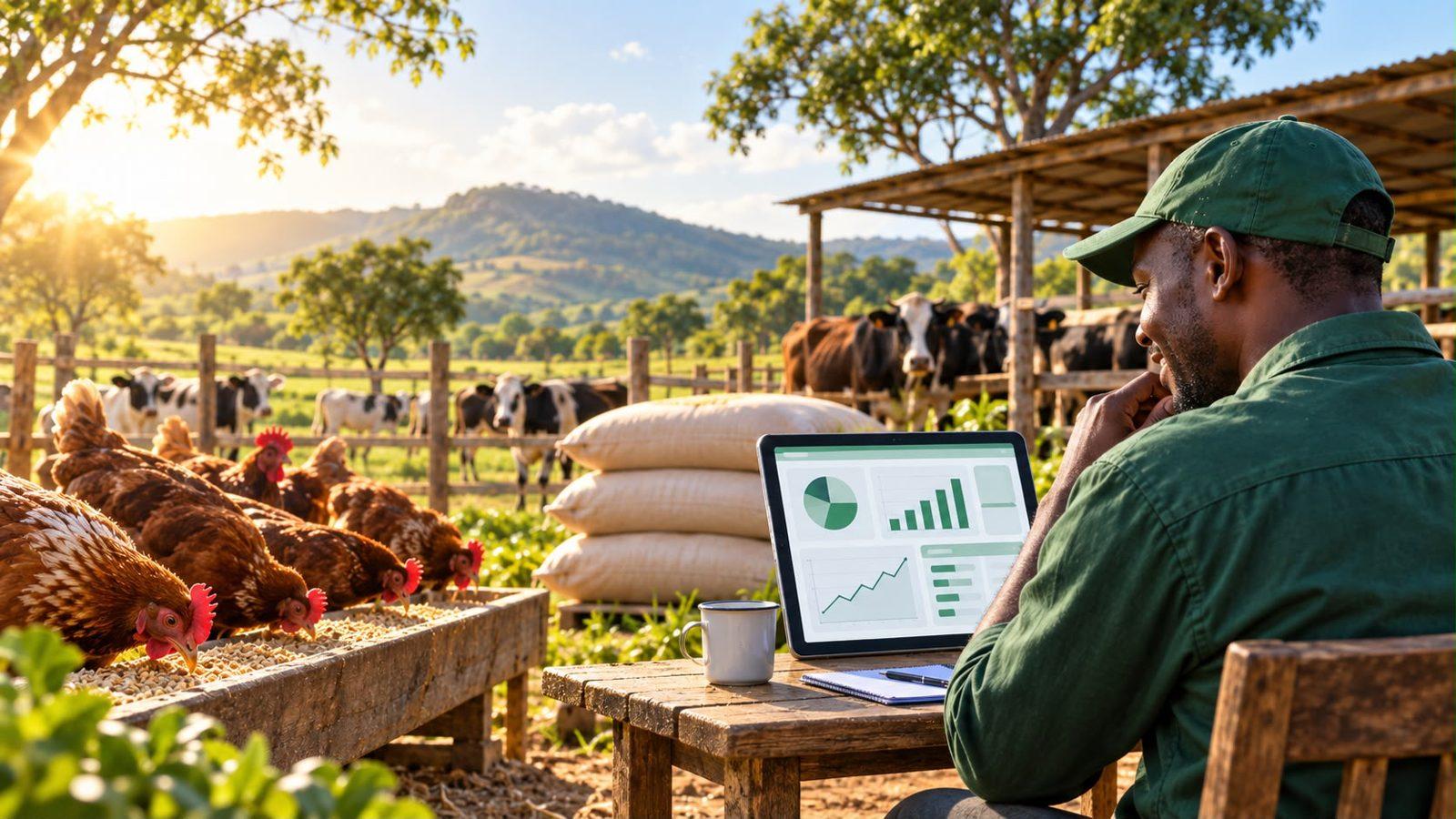
Feed Might Get Cheaper. But Is Your Farm Actually Making More Money?
There has been some interesting farming news coming out of South Africa this week, particularly around feed costs, livestock disease control and the financial pressure farmers are under.
But one thing keeps coming back to me:
A cheaper input does not automatically mean a more profitable farm.
That is something we have been thinking about a lot at StokData Africa.
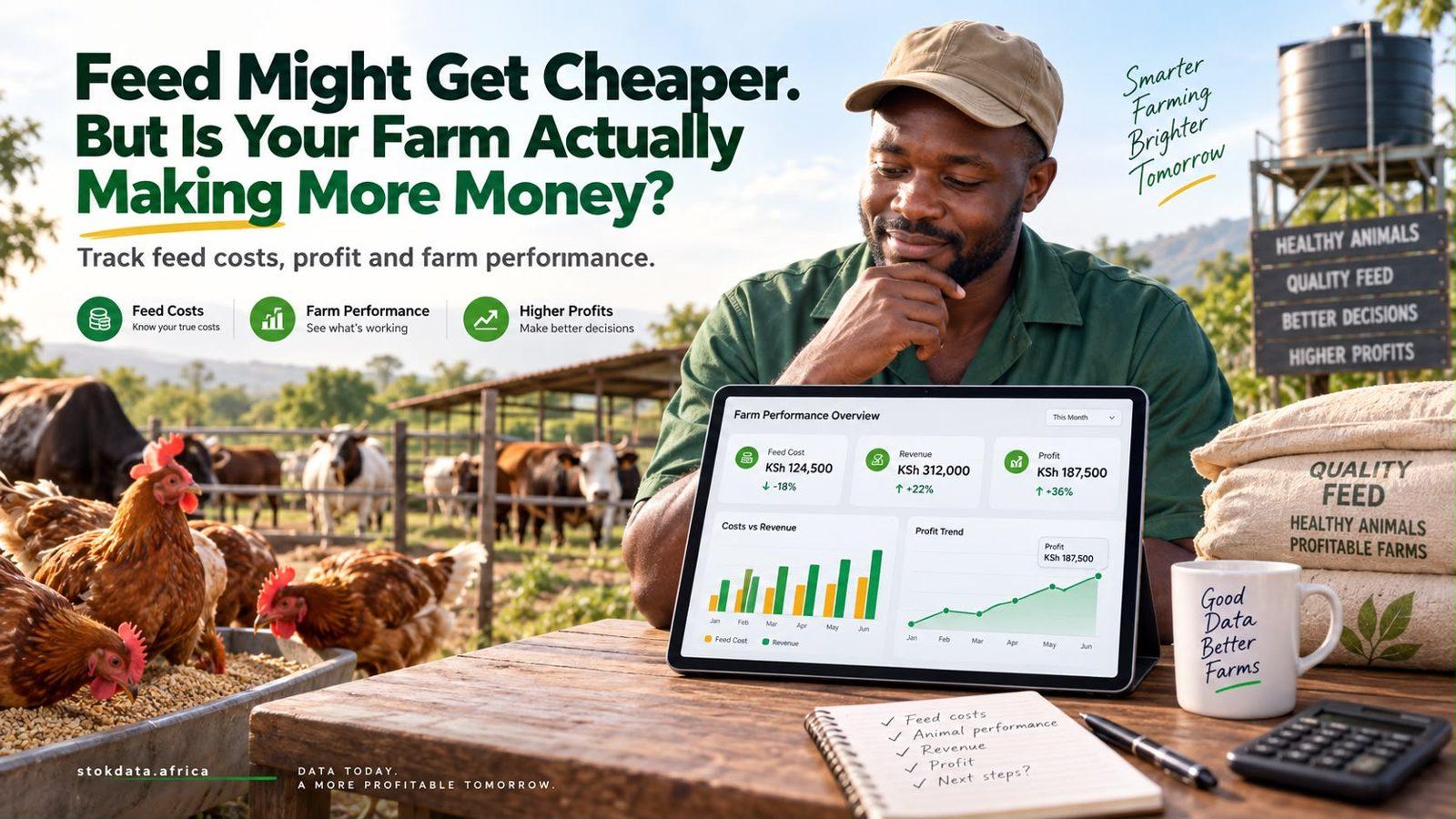
Short answer: cheaper feed only increases farm profit if you also track feed conversion, wastage, mortality, health costs and selling prices. StokData Feed & Profit is a farm management tool that works out feed cost per bird or animal, cost of production and profit per flock or livestock group from the records African poultry and livestock farmers already keep.
Does cheaper feed increase farm profit?
The latest outlook from South Africa points to changing prices across some of the major ingredients used in animal feed.
That sounds like good news when some feed ingredients are expected to become cheaper.
But farmers don't feed one headline to their chickens or cattle.
Your actual cost depends on what you are buying, how much you are using, how much is being wasted, how your animals are performing and, eventually, how much money comes back from them. Feed is usually the biggest single cost of production on a poultry farm, so feed cost per bird is the number to watch.
That is exactly why we recently updated StokData's Feed & Profit tools.
Instead of simply recording that you bought feed, farmers can start looking at questions like:
- How much feed did this flock actually consume?
- What did feed cost me per bird?
- What is it costing me per animal?
- How much feed are we wasting?
- After feed and the other costs, did this batch actually make money?
Sometimes the animal or flock that looks productive isn't necessarily the one making you money.
And sometimes the problem isn't your selling price. It is a cost quietly eating into your profit every week.
How do you work out the true cost of feed? A yellow maize example
Funny enough, I recently had a conversation with a mate about potentially bringing yellow maize from South Africa into Zimbabwe.
On the surface, you can look at the South African price and think:
"Haa, this could work."
But that's not enough.
- What will the maize cost?
- What will transport into Zimbabwe cost?
- What about clearing, handling and other expenses?
- Then, once it reaches the farm, what does that make our actual feed cost per bird or animal?
And most importantly:
Does buying it actually leave us better off?
That is the kind of decision I want farmers to be able to test before putting money down.
So StokData now includes a Future Profit Scenario calculator where you can change expected feed costs and other figures and see what those changes could mean for the profitability of a flock, batch or livestock group.
It doesn't tell you the future.
It helps you do the maths before you spend the money.
For me, that's much more useful.
What do disease and vaccination really cost a farm?
South Africa's continuing foot-and-mouth disease situation is another example.
New reporting shows that imported FMD vaccines accounted for almost 94% of Onderstepoort Biological Products' domestic sales during April to June, while private-channel prices for certain imported vaccines were reported at around R46 per dose. Prices charged to the Free State province were reported at R70 and R90 per dose for two vaccines.
South Africa has been importing millions of FMD vaccine doses while rebuilding local production capacity.
For a farmer, this isn't just an animal-health story.
It is also a record-keeping and cost story.
- Which animals were vaccinated?
- When?
- With which vaccine?
- How much did it cost?
- Which batch was used?
- How many animals were covered?
Good health records give you a history you can actually go back to instead of trying to remember what happened six months ago.
That is why StokData keeps livestock health and vaccination histories alongside the rest of the farm records, so vaccine spend shows up in your cost of production, not just in a health book.
Why does livestock traceability matter in Africa?
Another development I found interesting happened at a farmers' event in North West, South Africa.
Farmers were shown how location identifiers and animal-movement records can help trace where animals have come from and identify disease-risk areas. Importantly, this included engagement with emerging farmers.
This is where African agriculture is heading.
The question is slowly changing from:
"Why should I keep all these records?"
to:
"Can I actually produce those records when somebody asks for them?"
Animal movements, births, deaths, vaccinations, treatments and sales might feel like ordinary farm entries today.
Together, they become the history of your farm.
That is one of the reasons we built StokData to let farmers record livestock movements, health information, vaccinations, sales and other farm activity in one place, with data that can also be exported.
Can you improve farm profit without spending more money?
This might be the biggest issue of all.
Farmer's Weekly reported this week that smaller farmers are struggling to make some of the investments recommended for drought resilience because margins are already tight and equipment, labour and other costs still have to be paid.
That makes sense to me.
You can tell a farmer to buy another machine, install another system or make another major investment.
But where is the money coming from?
Sometimes the first technology a farmer needs isn't something that costs thousands.
It is simply a better understanding of where the money already going through the farm is being made or lost.
That's the direction we are taking with StokData, our farm management software for African poultry and livestock farmers.
Not just recording animals.
Not just recording feed.
Not just recording expenses.
We want those records to start answering the question farmers actually care about:
What is making me money, what is eating my money, and where can I save?
Because whether yellow maize becomes cheaper, vaccine prices change or another difficult season comes, the farmer who understands their own numbers is in a much better position to make the next decision.
Track it. Understand it. Then decide.
Frequently asked questions
What is feed cost per bird?
Total feed cost for a flock divided by the number of birds. It is the fastest way to see whether a cheaper feed price is actually reaching your bottom line.
Does StokData calculate profit automatically?
Yes. Feed & Profit uses the feed, sales, weight, mortality and cost records you already enter to show revenue, feed cost, other costs and profit per bird or animal for each flock, batch or livestock group. It works for broilers, layers, cattle, goats and other livestock.
Can I test a feed price change before buying?
Yes. The Future Profit Scenario lets you enter a different feed price, selling price, feeding period or mortality rate and see the projected profit. It never changes your real farm records.
Can I export my livestock records for a buyer, vet or inspector?
Yes. Health, vaccination, movement and sales records are kept in one place and can be exported, so you can produce an animal's history when somebody asks for it.
StokData Africa — Track. Protect. Grow.