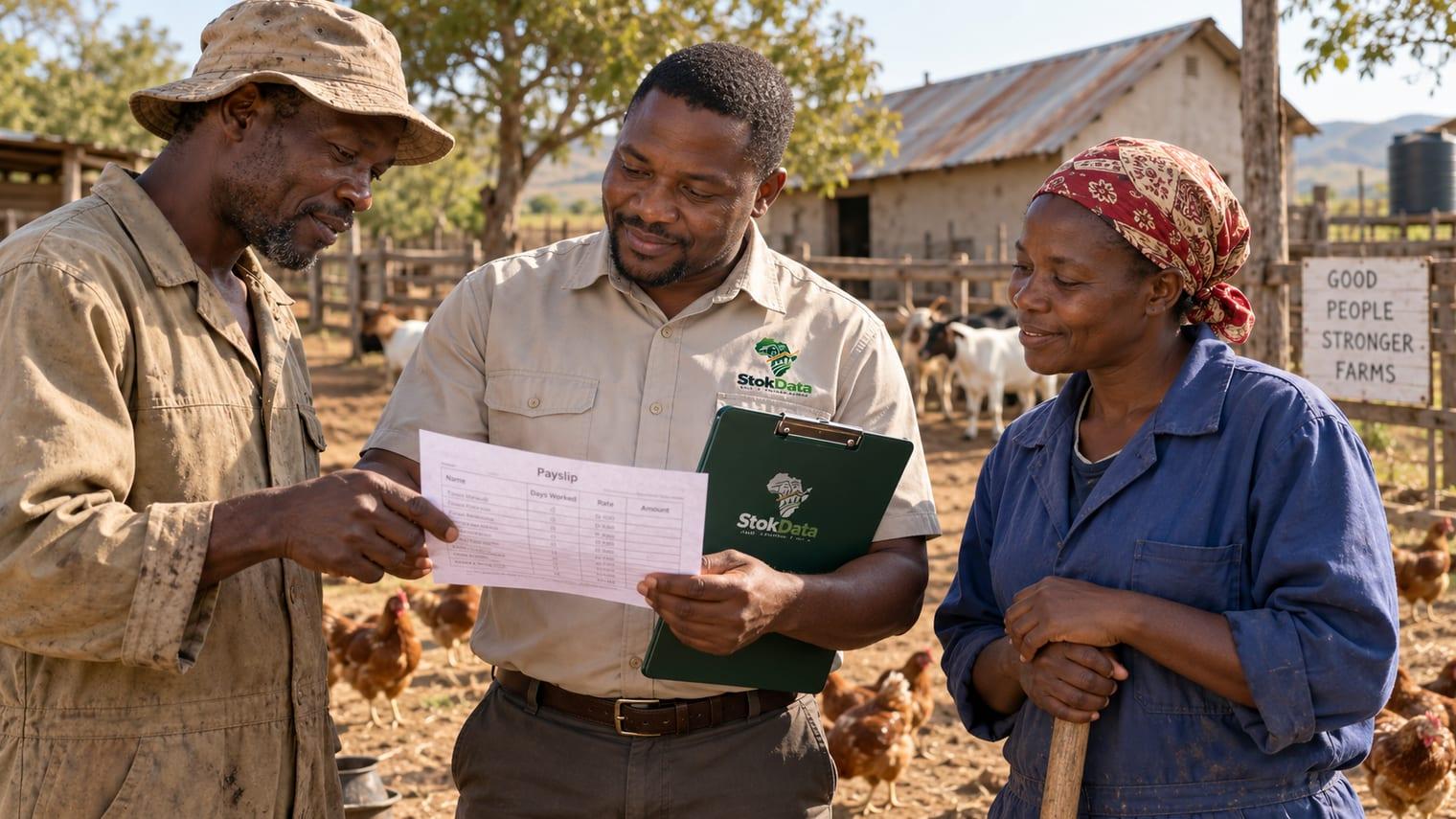
Zimbabwe Farm Payroll in 2026: NEC, NSSA and PAYE Explained for Farm Owners
The quick idea: Farm payroll is not only about paying a salary. It is about knowing the correct worker grade, recording hours and leave, applying the right deductions and contributions, meeting filing obligations, and keeping evidence of what was actually paid.
Running a farm is not only about livestock, crops and production.
The moment you employ people, the farm also becomes responsible for wages, working hours, deductions, contributions, payroll records and employment conditions.
For many Zimbabwean farm owners, this is where things become confusing: What grade is the worker? Which NEC Agriculture agreement applies? What should come off the worker's salary? What does the farm have to add? Where does NSSA fit? When does PAYE apply? And what records should you actually keep?
Most farmers are not deliberately trying to get payroll wrong. The rules are simply spread across different organisations, agreements, statutory instruments and tax systems. This guide brings the basics together in plain language.
Important: This article provides general information as at September 2026. It is not legal, tax, labour or payroll advice. Wage schedules, tax tables, contribution ceilings and procedures can change. For decisions affecting your farm or workers, use the latest NEC Agriculture, NSSA and ZIMRA information or speak to an appropriately qualified Zimbabwean professional.
Farm payroll is more than paying a salary
A worker may receive money at the end of the month, but proper payroll starts long before payday.
The farm needs to know who the worker is, what role they perform, their employment category, their correct grade, the applicable wage agreement, hours worked, overtime, leave, allowances and any lawful deductions.
Then the farm needs evidence showing what was calculated, what was deducted, what was actually paid and what was remitted to the relevant authority.
That is why good payroll is really about good records.
The three bodies farm employers commonly deal with
| Organisation | Main area |
|---|---|
| NEC Agriculture | Agricultural wages, grades and conditions of employment |
| NSSA | Social security, pension and workers' compensation |
| ZIMRA | PAYE, AIDS levy and employer tax administration |
NEC Agriculture publishes the industry's principal collective bargaining agreement and sub-sector wage agreements. NSSA administers social-security schemes including pension and workers' compensation. ZIMRA administers PAYE and the AIDS levy and publishes the tax tables employers use for employment tax.
Start with the right agriculture sub-sector
One of the easiest payroll mistakes to make is assuming that every Zimbabwean farm uses exactly the same wage schedule.
NEC Agriculture publishes separate agreements for sub-sectors including General Agriculture, Agro, Horticulture, Timber, Tea and Coffee, Sugarcane and Kapenta. Different sub-sectors can have different wage agreements, allowances and other requirements.
So before worrying about deductions or payslips, first answer a more basic question: Which agreement actually applies to this farm?
Then identify the correct grade for each worker. Covered agricultural grades run from A1 through C2, with the applicable wage depending on both the worker's role and the relevant sub-sector.
This is why copying another farm's payroll spreadsheet can be dangerous. The worker doing a particular job on one farm may not necessarily fall under the same wage arrangement as someone working somewhere else.
Hours, overtime and days off
The principal agricultural Collective Bargaining Agreement, S.I. 41 of 2022, provides that ordinary working hours should not exceed 208 hours per month and that employees receive at least one day off each week.
Hours above the ordinary monthly limit can become overtime. The agreement also treats ordinary overtime, work on a normal day off and public-holiday work differently.
This is why attendance records matter. If a farm does not record ordinary hours, overtime, days off, public-holiday work and leave, months later it can become very difficult for either the employer or worker to prove what actually happened.
Why "monthly pay divided by 26" appears in farm payroll
You may have seen agricultural payroll systems convert a monthly wage into a daily rate by dividing it by 26.
That figure is not something StokData invented. Section 10 of S.I. 41 of 2022 provides that, for purposes of converting a monthly wage, the daily equivalent is calculated by dividing the monthly wage by 26.
That is why a daily-rate calculation based on 26 days may appear on agricultural payroll records and payslips. The applicable agreement and worker circumstances still matter, particularly when calculating overtime, leave or other entitlements.
What comes off the worker's pay — and what the farm adds
The easiest way to understand payroll deductions is to separate worker deductions from employer contributions.
| Item | Worker | Employer |
|---|---|---|
| NEC Agriculture dues | 1.5% of basic wage | 1.5% of basic wage |
| NSSA POBS | 4.5% of insurable earnings | 4.5% of insurable earnings |
| NSSA workers' compensation / APWCS | — | Depends on classification |
| PAYE | Based on current ZIMRA tax tables | — |
| AIDS levy | 3% of PAYE after applicable credits | — |
NEC Agriculture dues
NEC Agriculture public guidance states that the employer deducts 1.5% of the covered worker's basic monthly wage or salary and contributes another 1.5%. That makes a total of 3% to be remitted in the currency in which the wage was paid.
For example, if the relevant basic wage were US$100, the worker's contribution would be US$1.50 and the farm would add another US$1.50, making US$3.00 in total.
NSSA Pension and Other Benefits Scheme
NSSA currently publishes an employee contribution of 4.5% of insurable earnings with a matching 4.5% employer contribution.
Its current public contribution guidance lists an insurable-earnings ceiling of US$700 per month and notes that the ceiling can change. That matters because the contribution is not simply calculated on unlimited earnings.
For example, where an employee earns US$900 and the applicable ceiling is US$700, each side contributes 4.5% of US$700, not 4.5% of the full US$900.
Workers' compensation
NSSA also administers the Accident Prevention and Workers Compensation Scheme. The employer contribution depends on the business's industry classification and applicable rate rather than being a standard employee deduction.
PAYE and AIDS levy
PAYE is calculated using ZIMRA's current tax tables and the employee's taxable remuneration. Where remuneration contains both local-currency and USD components, the current ZIMRA guidance for the payment period should be used.
The AIDS levy is 3% of the PAYE amount after applicable credits. Because tax bands can change, a farm should use the tax table for the actual year and payment period rather than carrying figures forward from an old payroll spreadsheet.
PAYE deadlines matter
ZIMRA employer guidance provides for PAYE returns (P2 forms) to be submitted online by the 5th day of the following month, while PAYE deducted is remitted by the 10th day of the following month.
The safest operational habit is simple: do not wait until somebody remembers. Build payroll deadlines into the farm's monthly routine.
For NSSA, use the current employer self-service portal and current NSSA instructions for the relevant contribution period. Because public NSSA material has used different wording about remittance timing, this guide does not state one fixed NSSA due date.
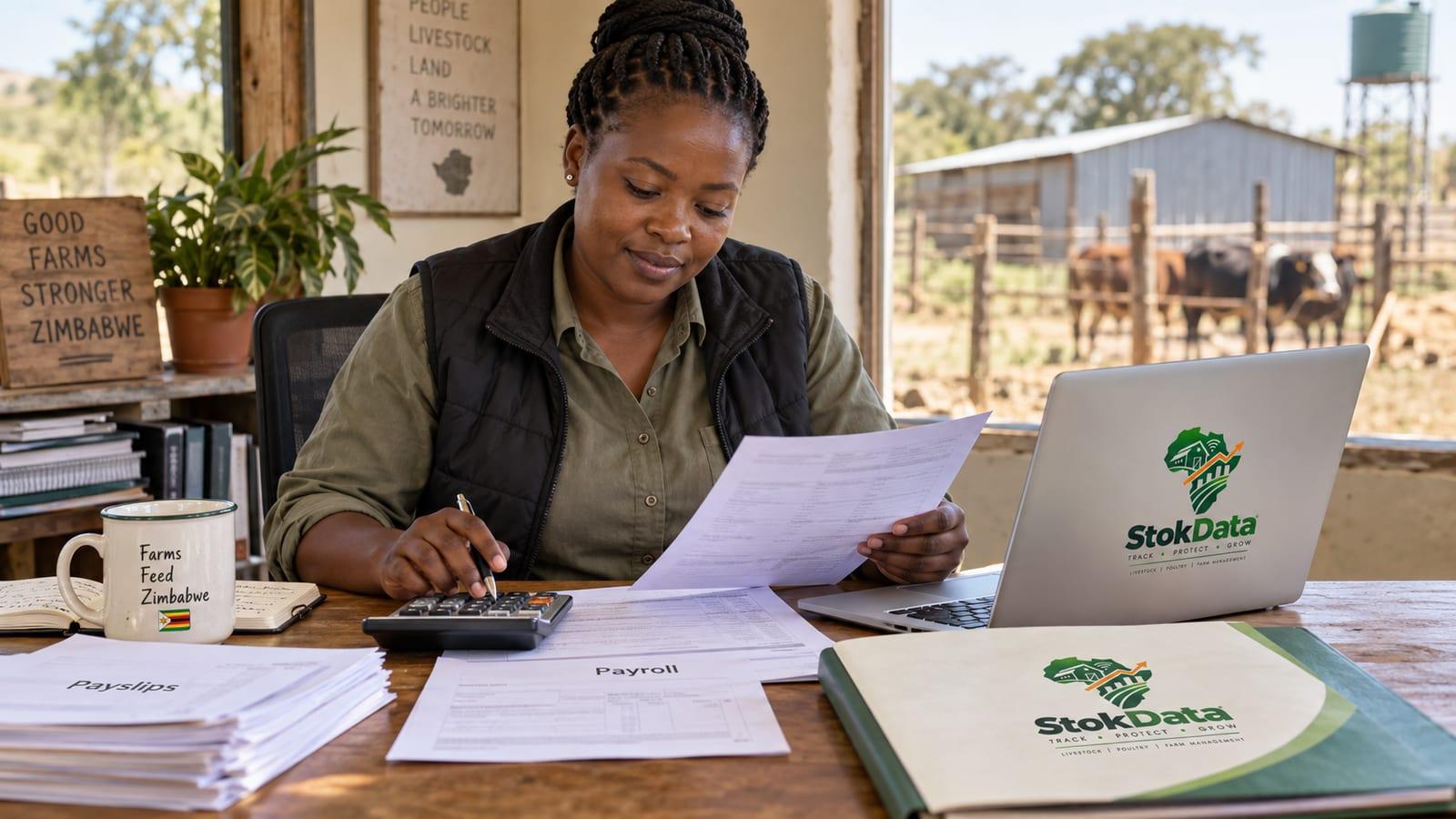
Keep the record behind the payroll. If an employee asks what happened three months ago, you should not have to search through WhatsApp messages, notebooks and somebody's old Excel file. StokData helps farms keep worker details, attendance, leave, payroll history and payslips connected to the wider farm operation.
How farm businesses get into trouble
Most payroll problems do not begin with one dramatic event. They build slowly.
- A worker is placed on the wrong grade.
- A wage schedule changes but the spreadsheet does not.
- Overtime gets agreed verbally but never recorded.
- A deduction appears on a payslip but is never remitted.
- Someone works on a public holiday and months later nobody agrees on how many hours were worked.
- A farm has five different versions of the same worker's payroll record.
- The person who normally handles payroll leaves — and takes all the knowledge with them.
That is why the real goal is not simply to produce a payslip. It is to create a payroll trail that another person can understand.
What a proper farm payslip should help show
A useful payslip should make the payment understandable to both the worker and the farm. Depending on the employment arrangement, that may include:
- Worker name, role and grade.
- Basic wage and relevant currency components.
- Ordinary hours, overtime, days off and public-holiday work where applicable.
- Allowances where applicable.
- NEC, NSSA and PAYE deductions where applicable.
- Leave information.
- Gross pay, net pay and payment date or payment reference.
A payslip does not prove that every legal obligation has been met. But it creates a much clearer record of what the farm says was calculated and paid, and makes discrepancies easier to identify while the information is still fresh.
Support exists for farms that need help
A farm that is struggling with wages or employment requirements should not simply ignore the problem.
NEC Agriculture publishes wage agreements, contract templates, job-evaluation material, declaration forms and information about exemptions and partial exemptions. NSSA provides employer registration and self-service facilities, while ZIMRA provides online tax-administration services.
Getting advice early is generally much easier than trying to rebuild payroll records after a dispute, inspection or missed remittance.
Where StokData fits. StokData is a farm-management platform. It is not NEC Agriculture, NSSA or ZIMRA, and it does not replace an accountant, labour adviser or tax practitioner. Its job is different: helping farms keep the operational records that payroll depends on.
A farm can keep worker information, roles and next-of-kin details; record attendance and leave; process monthly payroll information; generate printable payslips; and retain payroll history so previous records can be found again when needed.
Where the agricultural CBA applies, StokData can also use the monthly wage information recorded for a worker to produce the daily equivalent based on monthly wage divided by 26, consistent with the conversion rule in S.I. 41 of 2022.
StokData AI
StokData AI gives farmers another way to work with the information already recorded about their farm. For payroll, that can mean asking questions about worker, wage, leave and payroll information held in StokData.
StokData AI should not be treated as the source of official NEC, NSSA or ZIMRA rates. Official obligations should still come from the current agreement, tax table, statutory instrument or relevant professional advice.
StokData helps organise the farm's information. The authorities determine the rules.
Before you run farm payroll
Before each payroll cycle, a farm owner or manager should be able to answer these questions:
- Which agricultural sub-sector applies to us?
- What grade is each worker?
- What is the current wage agreement?
- What hours, overtime, leave and public-holiday work were recorded?
- What NEC and NSSA contributions apply?
- Does PAYE apply to this worker?
- Are we using the current ZIMRA tax tables?
- Does the payslip match what will actually be paid?
- Have the required deductions and employer contributions been remitted?
- Could we produce the records later if somebody asked for them?
If the answer to the last question is no, the payroll process is not really finished.
Frequently asked questions
I only employ a few workers. Does NEC Agriculture still matter?
Do not assume that having a small workforce automatically removes agricultural employment obligations. The appropriate sub-sector and worker grade determine which agreement applies.
Are all agricultural workers paid the same minimum wage?
No. Minimum wages vary by agricultural sub-sector and employee grade.
What are the agriculture worker grades?
Covered grades run from A1 to C2. The correct grade depends on the worker's job classification and the applicable agreement.
Is 208 hours per month a real agricultural payroll rule?
Yes. S.I. 41 of 2022 provides that ordinary working hours should not exceed 208 hours per month.
Why is a daily wage sometimes calculated by dividing monthly pay by 26?
Because S.I. 41 of 2022 provides that a monthly wage is divided by 26 when converting it to a daily equivalent.
How much are NEC Agriculture council dues?
Current public NEC Agriculture material states 1.5% of the basic monthly wage from the worker plus a matching 1.5% from the employer, making 3% in total.
How much is NSSA?
NSSA currently publishes a 4.5% employee contribution and matching 4.5% employer contribution, subject to the applicable insurable-earnings ceiling. The current public guidance lists a US$700 ceiling and notes that it can change.
What if a worker earns below the PAYE threshold?
The amount of PAYE depends on the current ZIMRA tax tables and taxable remuneration for that period. A nil PAYE calculation does not remove other record-keeping or employer obligations that may apply.
Can I simply pay everything in ZiG?
Do not assume so. Agricultural wage agreements can specify how a minimum wage is split or paid, so use the applicable schedule for the worker's sub-sector and grade.
What if the farm cannot afford the minimum wage?
Do not simply reduce the wage informally. NEC Agriculture publishes exemption procedures for qualifying cases, and the applicable process should be followed before relying on an exemption.
Good farm management includes the people
Farm technology often focuses on animals, crops, feed, production and sales.
But a farm is also a workplace.
People show up. People work hours. People take leave. People earn wages. Money is deducted. Money must be remitted. And months or years later, somebody may need to know exactly what happened.
That is why payroll should not sit outside farm management. It is part of it.
Know who worked.
Know what was paid.
Know what was deducted.
Keep the record.
StokData Africa — Track. Protect. Grow.
Livestock. Poultry. Workers. Payroll. Payslips. Farm records.
Know what is happening. Know what it is costing. Work with AI to manage your farm better.
Start your free 7-day trial at stokdata.africa.
Official sources to review before relying on this guide
This guide was prepared from public information available in September 2026. For live payroll decisions, use the newest official material. Key source areas include:
- NEC Agriculture resource centre and wage agreements
- NEC Agriculture FAQ
- S.I. 41 of 2022 — Agricultural Industry Collective Bargaining Agreement
- NSSA contributions guidance
- NSSA record keeping guidance
- ZIMRA PAYE explained
- ZIMRA tax payment dates