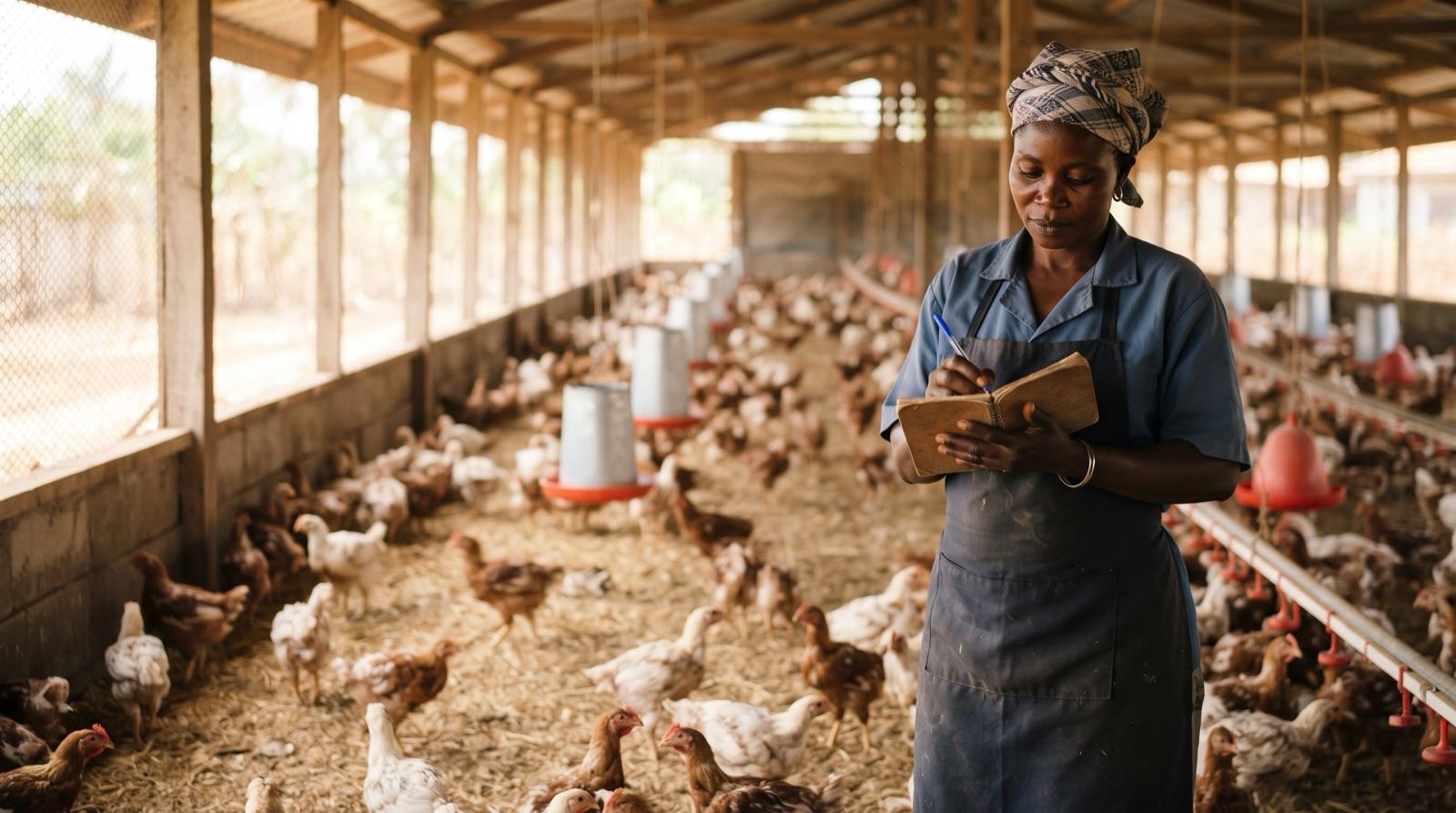
Free poultry record keeping template: what to write down every day
Most poultry farmers know roughly how their birds are doing. Fewer know exactly how many died this week, how much feed went in, or whether the last batch actually made money.
That gap is what poultry record keeping closes. You don't need fancy software to start. You need the same few numbers written down the same way, every day.
The five records worth keeping
- Flock record. For each batch: the date you placed the birds, how many, what you paid per chick, and where they came from.
- Daily log. Deaths, culls, eggs collected (for layers) and feed used.
- Costs. Feed, vaccines, medicine, labour, electricity, water, transport.
- Sales. Birds, eggs or manure sold: how many, the price, and who bought.
- Summary per batch. Pulled together at the end so you can see the result.
Keep every batch separate. Give each one a short name, like B1-OCT, and use the same name everywhere. Mixing batches together is the most common reason records stop being useful.
Three numbers to work out for every batch
| Number | How to calculate it | Why it matters |
|---|---|---|
| Mortality % | Deaths ÷ birds placed × 100 | A record to track from one batch to the next, so you can see how your results change over time. |
| Feed conversion ratio (FCR) | Feed used (kg) ÷ live weight sold (kg) | Shows how much feed it takes to produce a kilogram of bird. Lower is better. |
| Profit per bird | (Total sales − total costs) ÷ birds placed | Tells you whether the batch paid, and lets you compare one batch with the next. |

These numbers are records to track, not health advice. If you are worried about your birds, speak to a vet or an extension officer.
Free poultry record keeping template (Excel and PDF)
We built a simple Excel template with these sheets: Flock, Daily Log, Costs, Sales and a Batch Summary that fills itself in. It works for broilers, layers and kienyeji chickens. Use any currency. Prefer paper? There is also a printable PDF record book, like a poultry record book you fill in by hand.
How to use it:
- Add a row on the Flock sheet for each batch.
- Fill in the Daily Log every day. It takes a couple of minutes.
- Record costs and sales as they happen.
- Open Batch Summary to see mortality, feed, cost, revenue and profit.
The example rows are there to show the format. Delete them before you start.
When a spreadsheet stops being enough
Spreadsheets work well for one house and one person. They get harder when:
- You have several flocks or houses.
- Workers record the numbers and you are not on the farm.
- You are away from the farm and want to see how it is going.
- The phone has no signal in the poultry house.
That is why we built StokData, a poultry farming app that records flocks, feed, mortality, eggs, sales and profit in one app, works offline, and lets you see the farm from wherever you are. You can try it free for 7 days at stokdata.africa. See how it works for poultry farms.
Start small
If you only do one thing this week: write down deaths and feed used every day for one batch. Even that will tell you more than most farms know.